# LiDAR Annotation Tool

LiDAR Annotation Tool Overview

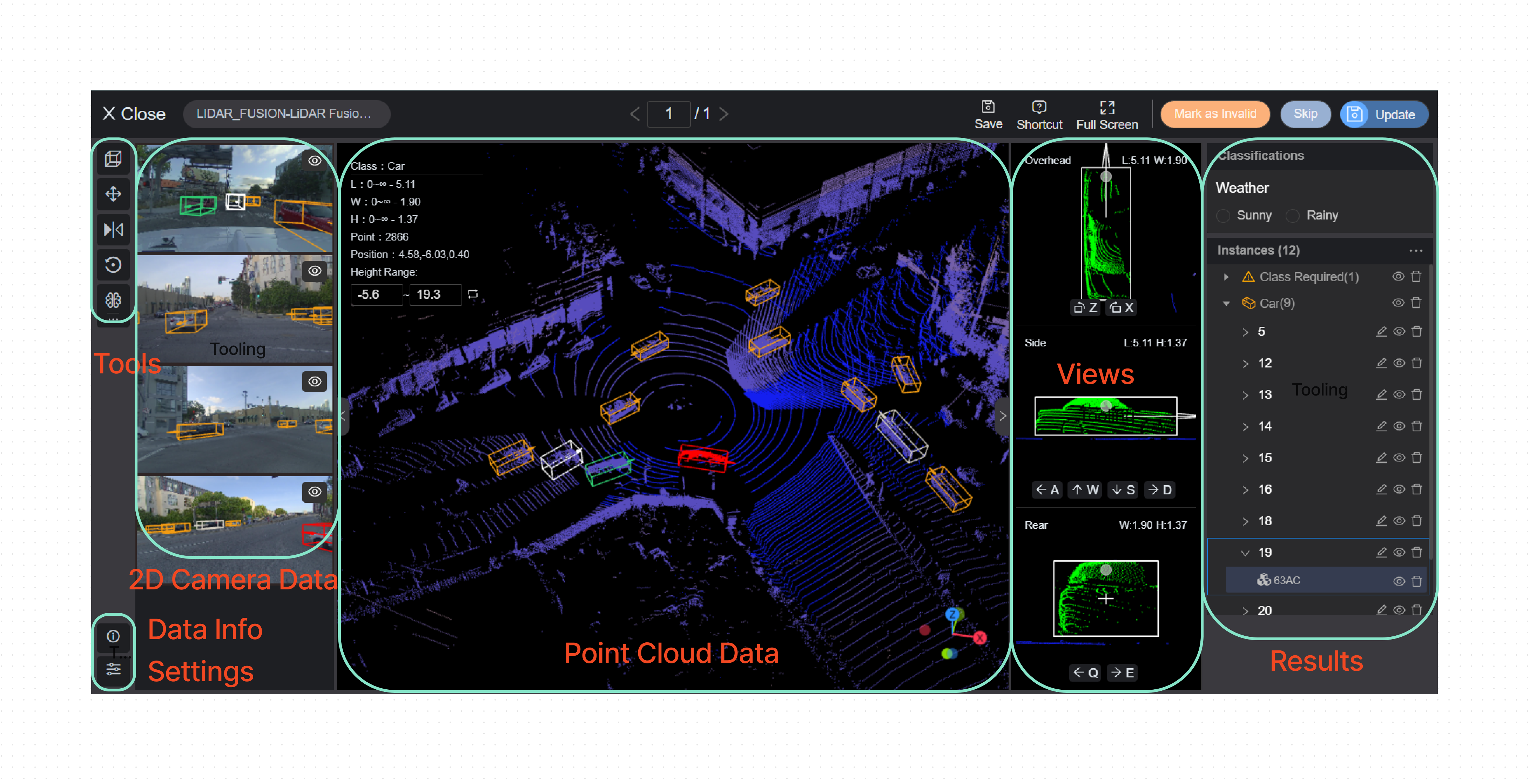
The main screen of the LiDAR annotation tool consists of the following components

<figure><img src="/files/mAgjUMwYtzEJ3GgPAJoY" alt=""><figcaption><p>LiDAR Annotation Tool Interface</p></figcaption></figure>

<table data-view="cards"><thead><tr><th></th><th></th><th></th></tr></thead><tbody><tr><td></td><td><p><strong>Tools</strong></p><ul><li><strong>Create Box</strong>: Create a new cuboid on 3D canvas;</li><li><strong>Translate</strong>: On/Off switch Move the cuboid when it is on; Support moving to a certain axis of X/Y/Z;</li><li><strong>Run Model</strong>: Run the model to predict results</li></ul></td><td></td></tr><tr><td></td><td><p><strong>RGB Camera Data</strong></p><ul><li>To project b-box/2d cuboid on 2d image;</li><li>If it is not a 2D &#x26; 3D Fusion dataset, 2d images are used for reference, helping to identify objects that are not clear in 3D.</li></ul></td><td></td></tr><tr><td></td><td><p><strong>Point Cloud Data</strong></p><ul><li>Annotate objects according the data annotation guideline;</li><li>AI-assisted tool can precisely make the cuboid fit on the object automatically</li></ul></td><td></td></tr><tr><td><p><strong>Settings</strong></p><ul><li>There are many settings that can help annotators better identify objects. </li></ul><p>For example, by displaying the intensity value of points, changing the size of points, etc.</p></td><td></td><td></td></tr><tr><td><strong>3-Views Area</strong></td><td><ul><li>When a cuboid is created on the 3D point cloud data area, minor adjustments are usually made here to make the cuboid fit as closely as possible to the target object.</li></ul></td><td></td></tr><tr><td><strong>Results</strong></td><td><ul><li>All annotation results are displayed here, including Validity, Classification and Class results.</li></ul></td><td></td></tr><tr><td><p><strong>Data Info</strong></p><p>Display data information, including coordinate values and the total number of points.</p></td><td></td><td></td></tr></tbody></table>

## Start to Annotate

Click **Create** (or hit F on the keyboard) on the upper right corner, click 3 time to draw the outline of the object, then a cuboid that fits the object will be generated by the AI-assisted tool.

<figure><img src="/files/NkvTCUn7tguMsWn9L2rm" alt=""><figcaption><p>AI-assisted 3D Cuboid Tool</p></figcaption></figure>

## Adjust

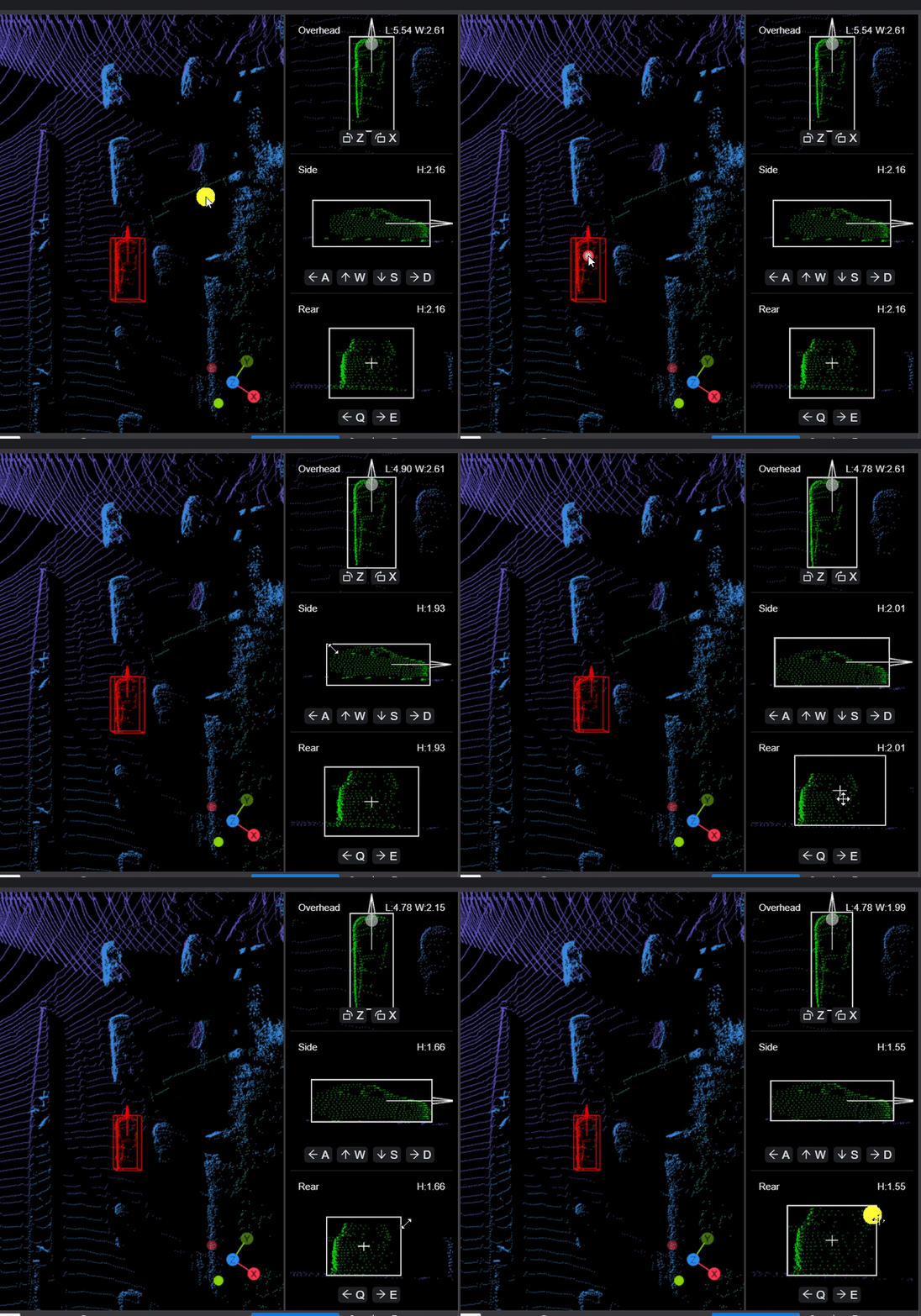
In most cases, slightly adjust the cuboid in three different views: overhead, side and rear views.

Hit **C** on the keyboard to change the cuboid facing direction.

<figure><img src="/files/BKiS6P8fSJyYZv7pi0g2" alt=""><figcaption><p>Adjust 3D Cuboid in 3 Views Area </p></figcaption></figure>

{% hint style="success" %}
It is recommended to use shortcut keys to adjust the position.
{% endhint %}

<table><thead><tr><th width="166.33333333333331" align="center">Shortcut Key</th><th width="220" align="center">Check in 3 Views</th><th align="center">Function </th></tr></thead><tbody><tr><td align="center"><strong>Z X</strong></td><td align="center">Check in Overhead view</td><td align="center">Rotate Clockwise / Counterclockwise</td></tr><tr><td align="center"> <strong>A W S D</strong></td><td align="center">Check in Side view</td><td align="center">Move to Left / Up/ Down/ Right </td></tr><tr><td align="center"><strong>Q E</strong></td><td align="center">Check in Rear view</td><td align="center">Move to Left / Right</td></tr></tbody></table>

Note: Using shortcuts do not reset the scale of three views.

## Projection & Re-projection

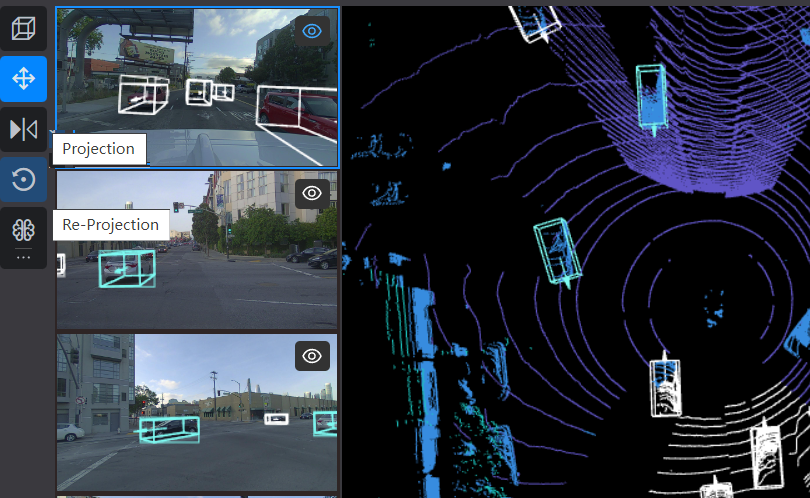
If you're working on a 2D & 3D fusion dataset, Projection and Re-projection button can project a bounding box or cuboid to the RGB images from point cloud data.

You can adjust the bounding box and cuboid in RGB images, click Re-Projection to reset the result.&#x20;

<figure><img src="/files/gRNkMf9xhQ9aJ8DteopJ" alt=""><figcaption><p>Project 3D Results to the RGB Image</p></figcaption></figure>

## AI Model Pre-annotation

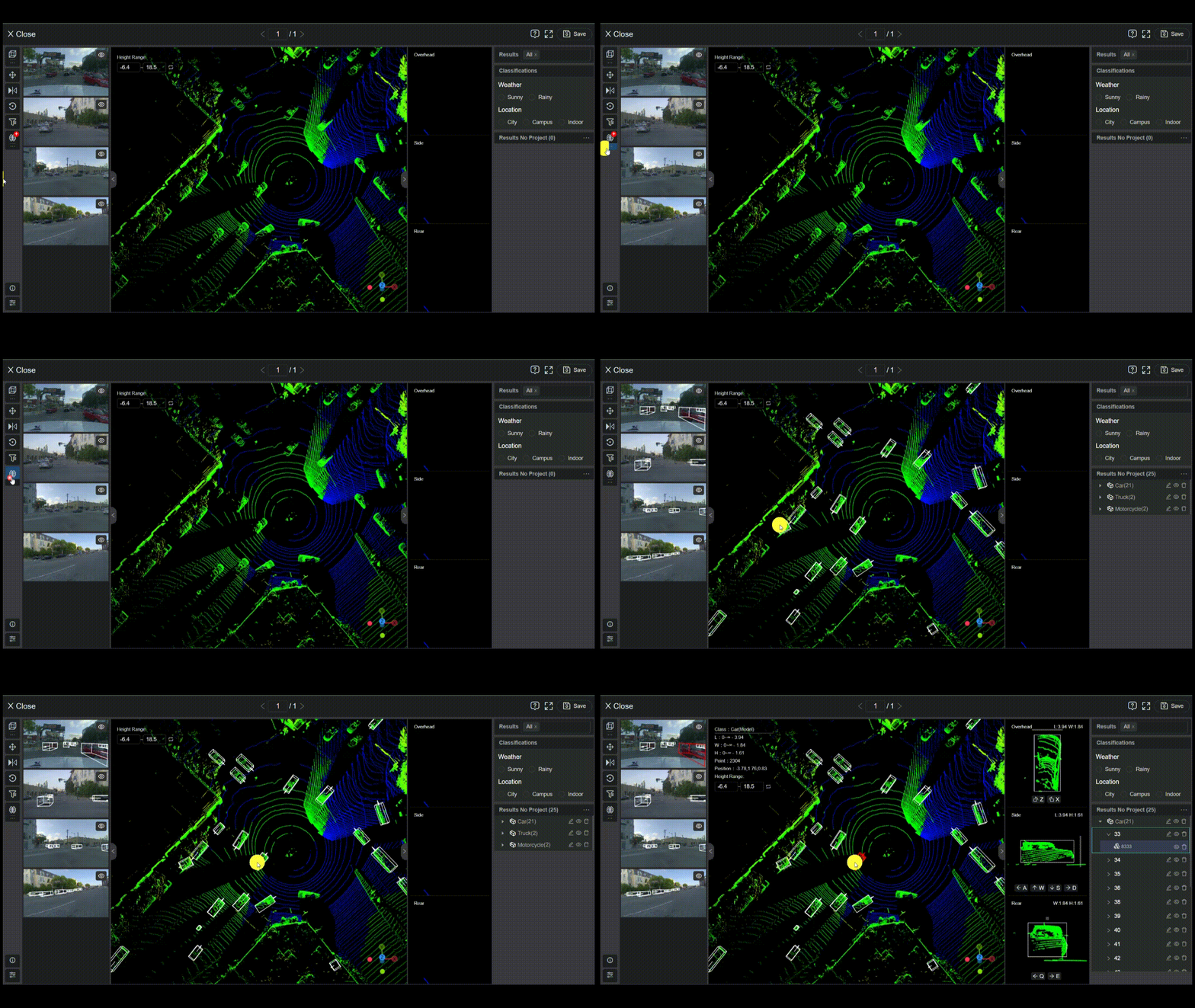
Xtreme1 platform has preset models for ADAS scenarios -- only by clicking one button to auto-generate results. Yon can also integrate other models into the Xtreme1 platform. See Model Page.

Click **Run Model** button to apply a model to auto-annotate objects in 3D point cloud data. Click the button again to load results after recognition.

<figure><img src="/files/g9jVrFJWyoIiLir63ibU" alt=""><figcaption><p>3D Object Detection Model Tool</p></figcaption></figure>

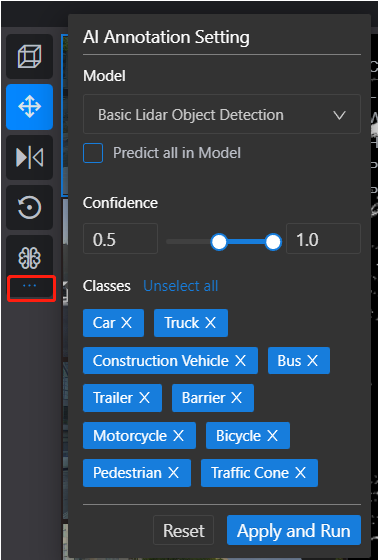
Running model predicts all targets in point cloud data by default, you can choose preferred classes and confidence value in AI Annotation Setting.

<figure><img src="/files/f1qb2OpPaI6eBTfYlLCb" alt=""><figcaption><p>Pre-annotation Model Setting</p></figcaption></figure>

## Data Info

Click **Info** button on the lower left corner to show Coordinates, Points of selected scene results.

## Display Setting

Click **Setting** below data info to customize display effects of Image, Point cloud and Result etc.

1. Image: Tick checkboxes to show Cuboids, 3D Cuboids, Projected Cuboids and Projected Points
2. Point Cloud: Points - Point size in 3D point cloud; Color Height / Intensity - Slide or input value to modify point cloud render color; Click **Reset** to reset to default value;
3. Objects：Switch to show tags on results;
4. Utility：Switch to show distance measure and its radius in meter.

## Shortcuts List

|         Key        |                 Description                |
| :----------------: | :----------------------------------------: |
|     **Actions**    |                Shortcut key                |
|          F         |                Create Object               |
|     Ctrl/⌘ + C     |                 Copy Object                |
|     Ctrl/⌘ + V     |                Paste Object                |
|    Ctrl/⌘ + Drag   |             Copy by Drag Object            |
|         Del        |                Delete Object               |
|     Ctrl/⌘ + Z     |                    Undo                    |
| Ctrl/⌘ + Shift + Z |                    Redo                    |
|          U         |            Turn on/off Auto Fit            |
|   **Edit Cuboid**  |                Shortcut key                |
|         W/S        |             Move Cuboid Up/Down            |
|         A/D        |        Move Cuboid Backward/Forward        |
|         Q/E        |           Move Cuboid Left/Right           |
|         Z/X        | Rotate Cuboid Clockwise / Counterclockwise |
|          T         |    Show/Hide Classes and Attributes Pad    |
|          M         |               Show/Hide Label              |
|          C         |            Change Head Direction           |
|          V         |                  Filp Head                 |
|     **Display**    |                Shortcut key                |
|          G         |          Show/Hide Coordinate Axis         |
|          B         |       Filter Other Object in 2D View       |
|          N         |         Show/Hide Distance Measure         |
|          R         |           Open/Close Review Panel          |

### Tutorials&#x20;

{% embed url="<https://www.youtube.com/watch?t=50s&v=4jo2FFVGJi0>" %}
Xtreme1 Tutorial Series Episode 2: Annotation of 2D & 3D Fusion Data
{% endembed %}


---

# Agent Instructions: Querying This Documentation

If you need additional information that is not directly available in this page, you can query the documentation dynamically by asking a question.

Perform an HTTP GET request on the current page URL with the `ask` query parameter:

```
GET https://docs.xtreme1.io/xtreme1-docs/product-guides/lidar-annotation-tool.md?ask=<question>
```

The question should be specific, self-contained, and written in natural language.
The response will contain a direct answer to the question and relevant excerpts and sources from the documentation.

Use this mechanism when the answer is not explicitly present in the current page, you need clarification or additional context, or you want to retrieve related documentation sections.